Wait… Filling Out the Canadian Census Is Required by Law?
Required by Law?
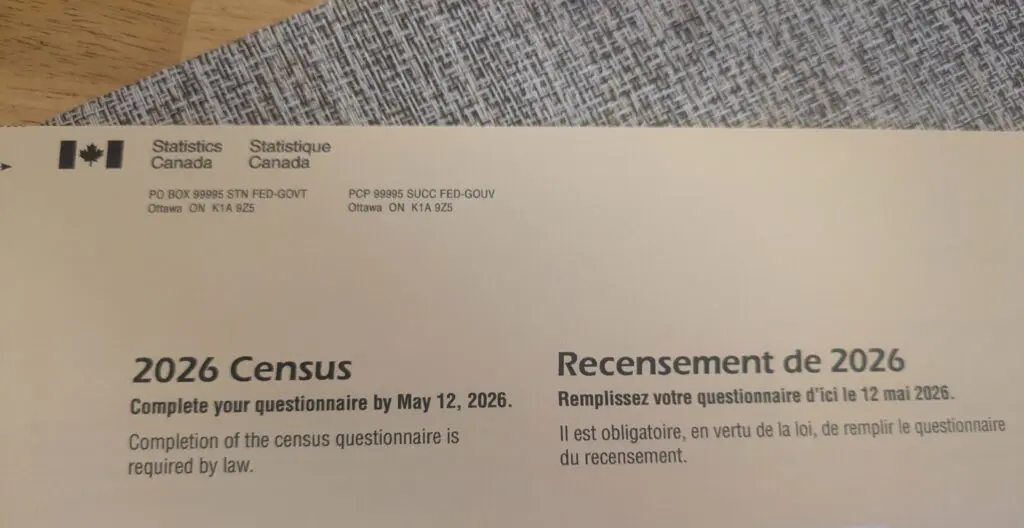
Yesterday, I received my 2026 Canadian Census Questionnaire, and while reading it, I saw that completing it is required by law. This made me wonder (ok maybe I should have paid attention in history classes 😉 ) have the Censuses always said that and if not when did that change. Here’s what I found out.
Census participation has been mandatory since the first national census in 1871
The first Canadian national census after Confederation was conducted in 1871, and participation was required by law.
The constitutional basis goes back to the Canadian Confederation and Section 8 of the Constitution Act, 1867, which required a census every ten years to determine representation in Parliament.
Later, the Federal Statistics Act formalized the legal obligation. The modern Statistics Act dates back to 1918 and gives Statistics Canada the authority to require responses to the Census of Population and the Census of Agriculture.
Was it always enforced?
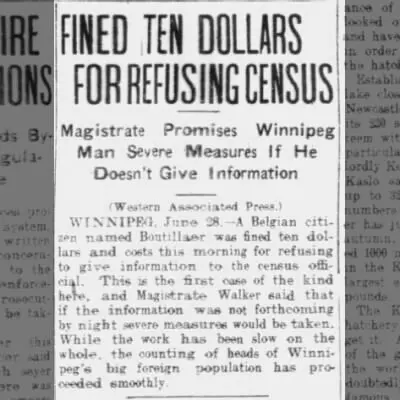
Edmonton Journal, Edmonton, Alberta, Canada · Thursday, June 29, 1911
Technically, yes — there have long been penalties available under the law for refusing to complete the census. However, enforcement historically has been relatively rare.
Statistics Canada generally follows a progression:
- Reminder letters
- Phone calls
- Enumerator visits
- Possible referral for prosecution in rare refusal cases
Statistics Canada itself stated during the 2021 census that refusal cases could be referred to the Public Prosecution Service of Canada.
Interestingly, there have actually been people prosecuted for census refusals in Canada, although it appears to have been uncommon. One well-known case involved a 79-year-old Toronto woman who was found guilty in 2014 after refusing to complete the 2011 census. Another involved Saskatchewan activist Sandra Finley, whose refusal to complete the 2006 census led to a lengthy legal battle.
What were the penalties?
Historically, penalties included both fines and possible jail time.
Under earlier versions of the Statistics Act, refusing to complete the census could result in:
- fines,
- imprisonment,
- or both.
However, an important change occurred before the 2016 census:
- imprisonment penalties for refusing census participation were removed from the law,
- But fines remained possible.
Today, the typical penalty mentioned is a fine of up to $500 for refusing or neglecting to provide required information.
One important historical exception: the 2011 long-form census
You may remember the controversy around the 2011 census.
In 2010, the federal government changed the mandatory long-form census into a voluntary National Household Survey. The short-form census remained mandatory.
That change was widely criticized by statisticians, researchers, genealogists, historians, municipalities, and social scientists for reducing data quality.
The mandatory long-form census was reintroduced in 2016 under the Trudeau government. I was given the long form.
Did Canada actually prosecute people?
Yes, although prosecutions were uncommon.
There were cases over the years in which people who refused to complete the census were charged or fined. Statistics Canada generally treated prosecution as a last resort after repeated refusals.
The agency has historically emphasized compliance through follow-up rather than aggressive prosecution.
Useful source links
Government of Canada / Statistics Canada
- Statistics Act (Justice Canada)
- 2026 Census FAQ – Statistics Canada
- Guide to the 2021 Census – legal requirement to respond
- 2021 Census data collection and refusal cases
Background / explanatory sources
Are you interested in joining my pack? By signing up for my newsletter, you’ll be sure to receive notifications of blog and video posts, and you’ll also receive offers from my trusted partners. Just click the picture below.