Naming Patterns
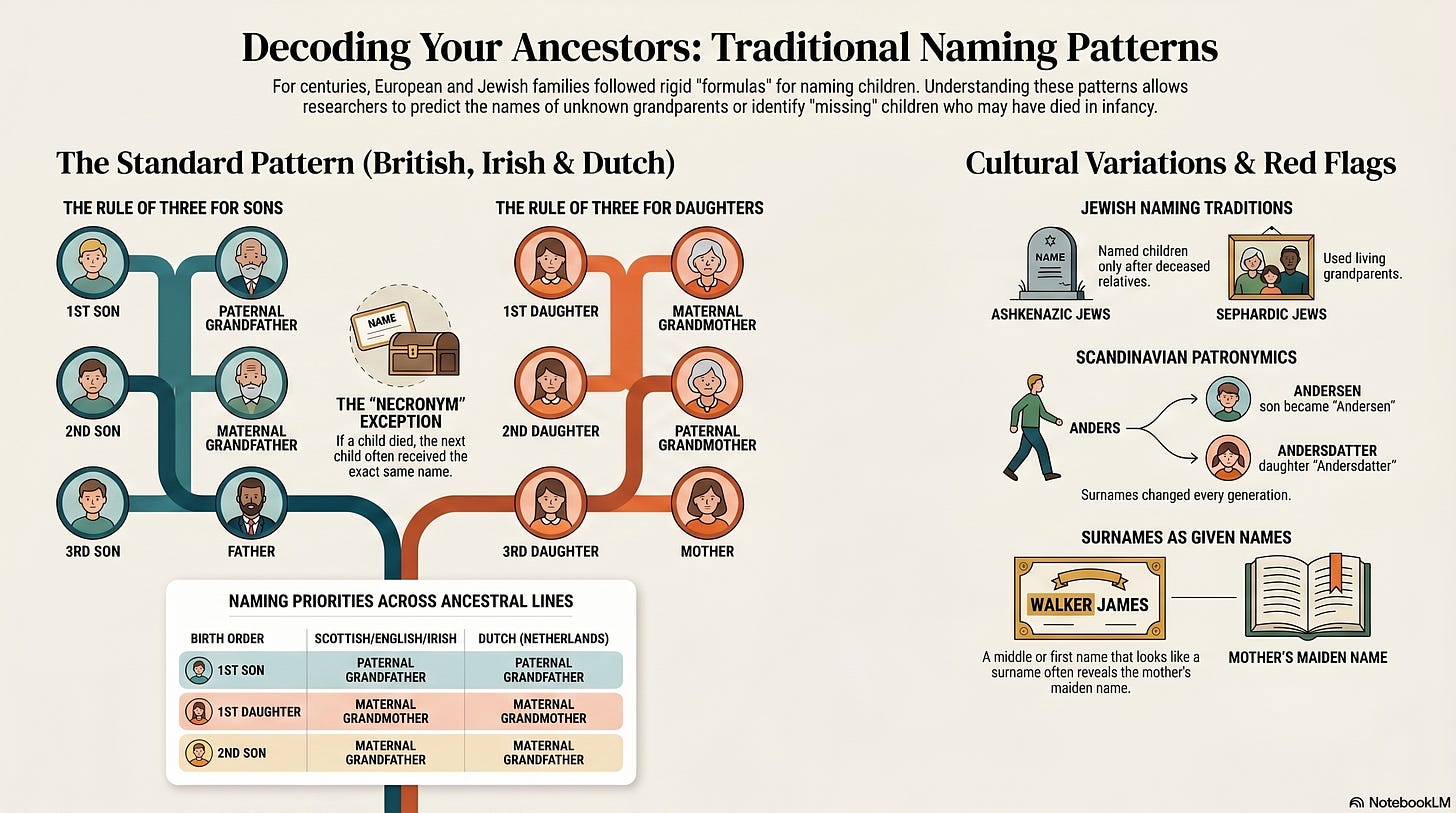
Graphic created at NotebookLM
At the beginning of 2026, I made a commitment to write a specific blog each month, at the very minimum. At the bottom of this blog, you’ll find the list. It’s the last day of May, so I’d better get busy on this one.
When I think of naming patterns, I think of the patterns that I’m most familiar with. That of how each child’s first name came to be, the oldest son was named after the paternal grandfather, the second son after the maternal grandfather, and then the third son after the father. In the case of daughters, the first daughter is named after the maternal grandmother, the second daughter after the paternal grandmother, and the third after the mother. Or some families choose to name their firstborn son after the father, giving that Sr. Jr. status, and the first female child after the mother.
I remember that growing up, I didn’t like the fact that I was named after a “dead person”. But now that I’ve worked on my family history, I’m honored to have my great-grandmother, Ellen Middlebrough’s name. I always think of her as a strong woman, and so I can relate.
In my lifetime, this first-name naming practice has changed as people want their children to be individuals with unique names.
In the time period of 2020-2025, the top three unique names for children with fewer than five children receiving those names in a year are:
Female
- Ocean (French origin; means “ocean”)
- Plum (English word name; fresh and botanical)
- Dreamy (American word name; whimsical)
Males
- Conran (Irish origin; means “counsel”)
- Guthrie (Scottish origin; a surname meaning “windy nook”)
- Haddon (English origin; means “heather-covered hill”)
If you’d like to see the complete list of names, at least for the US, you can find them at the US Social Security Site.
Statistics Canada doesn’t give us unique names; it gives us a list of popular names, with the top three for boys being Liam, Noah, and Theodore (my brother Ted will be happy), and the top three for girls being Olivia, Charlotte, and Emma. You can find the complete list of the top 20 names on the Baby Names Observatory. You’ll see that old-fashioned names seem to be making a comeback.
Scandinavian
But naming patterns mean something different when you think of Scandinavian countries, where I think of Patronymic names, such as the example in the graphic above, where the father’s name is used, and it changes with each generation. I often admire the researchers I know from those countries because I think it would be quite challenging to keep track of them.
German
In some German communities, children received multiple given names, with one serving as a religious or baptismal name and another used in daily life.
For example, several brothers might all be named Johann, but each would have a different second name:
- Johann Georg
- Johann Michael
- Johann Peter
This can create confusion when researching records.
French and French-Canadian
I’ve struggled with these naming practices, given the research and tree-building I’ve done while working on my grandfather’s mystery father, who was French Canadian.
French-Canadian families often used “dit” names, which acted as aliases or branch names.
A family might appear in records under several different surnames, making it important to understand local naming customs before assuming they are unrelated families.
Middle Names as Clues
Middle names can be genealogy gold.
Families frequently used:
- Mother’s maiden surname
- Grandmother’s surname
- Important family surnames
- Names of respected community members
A child named William Thompson Beaton may be carrying clues to several generations of family history.
Nicknames and Variations
Our ancestors did not always use the names we expect.
Examples include:
- Peggy for Margaret
- Polly for Mary
- Sally for Sarah
- Jack for John
- Betsy for Elizabeth
Spelling variations were also common. Many people could not read or write, and names were recorded phonetically by clerks, ministers, and census takers.
When Naming Patterns Help Solve Mysteries
But we need to remember that naming practices should never be considered proof of a relationship. But they can provide clues.
Suppose you have identified a couple named William and Mary, but you cannot locate the husband’s parents. Their first son is named John, and their second son is named Robert. The name alone does not prove a connection, but it can point your research in a direction, and you may then find further proof of the relationship.
Final Thoughts
Families did not always follow traditions. Children might be named after a beloved aunt, a family friend, a minister, or a local hero. Some parents simply chose names they liked.
The next time you enter a name into your family tree, pause for a moment.
Ask yourself:
- Who might this child have been named after?
- Does this name appear elsewhere in the family?
- Is there a cultural tradition at work?
- Could this name provide a clue to an unknown ancestor?
Sometimes the biggest breakthroughs in genealogy begin with something as simple as a name.
If you enjoyed this blog, why not join my pack?
Sign up for my newsletter below and be the first to hear about new blog posts, YouTube videos, and exclusive offers from my trusted genealogy partners.